Posts

The Rambutan

Image
Rambuatan ( Nephelium lappaceum ), according to popular belief and the origin of its name, rambutan is native to Indonesia and Malaysia, the name rambutan is derived from the Indonesian/Malay word rambutan, meaning "hairy", rambut the word for "hair" in both languages, a reference to the numerous hairy protuberances of the fruit. But rambutan also can be found in elsewhere in Southeast Asia region like Thailand, Myanmar, Vietnam and also in South Asia like India and Sri Lanka. The Rambutan Rambutan fruit have the outer shell shaped to resemble hair. Generally  color of fruits are green when young, changed to yellow when the fruit is old, and then turn to red when the fruit is ripe. But in malaysia there are varieties of rambutan skin still yellow when ripe. Scientific classification : Regnum              : Plantae Division              : Magnol...

Dragon fruit or Pitaya (Hylocereus)

Image
Pitaya or dragon fruit (part genus Hylocereus) is a cactus plant that originated Mexico, Central America, and North America and are now spread all over the world. In the region of origin this plant named pitahaya dragon fruit or pitaya roja. Residents there often utilize this fruit to be served as fresh fruit consumption.  Dragon fruit or Pitaya (Hylocereus) Although originating from North and Central America, dragon fruit became known as the plant from Asia; because this is precisely the dragon fruit has been cultivated on a large scale in several Asian countries, especially the countries of Vietnam, Thailand, and Indonesia. This plant was originally intended as an ornamental plant, because the triangular shape and spiny stems short and has a beautiful flower shaped like a funnel and started to bloom at dusk and will bloom at night. Characteristic of the tree: Dragon fruit plant is a climbing plant species. In their natural habitat, these plants live by climbing othe...

Pangium edule or keluak or keluwak or pucung

Image
The seeds Pangium edule  is a tall tree native to the rivers banks and mangrove swamps of Southeast Asia (Indonesia, Malaysia, and Papua New Guinea). The fruit of Pangium edule has its native name keluak, keluwak, pucung, or picung in Indonesia and kepayang in Malay. Pangium edule fruit is a large poisonous fruit, however, through the fermentation process, local residents of the area can change the fruit seeds become an important part of the region's culinary. Characteristic of the tree: Kluwek or kepayang is a straight trunked tree; capable of reaching 60 feet high with a trunk diameter of up to 120 cm. Branches are not too tight. The leaves are heart-shaped, with a width of 15 cm. and length 20-cm. dark green and shiny on top, while the bottom is rather whitish and slightly hairy. This plant grows in the wet tropical rainforest and is a native plant that grows from Southeast Asia to the western Pacific. Kepayang Flacourtiaceae family member who is able to gr...

Pisum sativum (Pea)

Image
Pisum sativum (Pea) is an annual plant, with a life cycle of one year. This area is cold and plants grown in different parts of the world, planting can take place from winter to early summer depending on location. For the tropical type of pea is grown in areas of high, which is cool, this plant produce peas, when young will be used as fresh vegetables, especially in Asian countries. The nuts grow wild within the Mediterranean basin and the Near East. Note that the archaeological data, peas has existed since the end of the Neolithic period in the region that is now known as Greece, Syria, Turkey, and Jordan. In Egypt, found the initial date of 4800 - 4400 BC in the Nile delta area, and from ca. 3800-3600 BC in Upper Egypt. Nuts are also present in Georgia in the 5th millennium BC. Peas are present in Afghanistan 2000 BC, in Harappa, Pakistan, and in northwest India in 2250-1750 BC. In the second half of the second millennium BC, this pulse crop appears in the Ganges basin and so...

Bilimbi or Averrhoa bilimbi

Image
  Averrhoa bilimbi Bilimbi or Averrhoa bilimbi , originated to Moluccas, Indonesia , the species are now cultivated and found throughout the South East Asia region like Philippines, Indonesia, Sri Lanka, Bangladesh, Myanmar (Burma) and Malaysia. It is also common in other Southeast Asian countries. In India, where it is usually found in gardens, the bilimbi has gone wild in the warmest regions of the country. Outside of Asia, the tree is cultivated in Zanzibar. In 1793, the bilimbi was introduced to Jamaica from Timor and after several years, was cultivated throughout Central and South America where it is known as mimbro. Introduced to Queensland at the end of the 19th century, it has been grown commercially in the region since that time. Characteristic of the tree: Small tree, reaching 10 m tall with a trunk that is not so big and has a diameter only about 30 cm. Trunk bumpy and uneven. Bilimbi has a bumpy rough trunk , branching slightly , leaning over him . You...

Tomato (Solanum lycopersicum syn)

Image
Tomato (Solanum lycopersicum syn) is a plant belonging to the family Solanaceae, native plants of Central and South America, from Mexico to Peru. Tomato is a plant with a short life cycle, can grow as high as 1 to 3 meters. Tomato is a close relative of the potato. Tomato is a fruit that is more often used as a fruit vegetable that is very famous and be a part of the dining table anywhere in the world. Originate from subtropical climates in South America, but now has spread throughout the world. According to the article, by Andrew F. Smith's "The Tomato in America,” the tomato probably originated from the highlands of the west coast of South America. After Spanish colonized South America, they spread the tomato plants into their colonies in the Caribbean. Spanish also brought the tomato to the Philippines then, is the starting point for the spread to other areas in the entire continent of Asia. Spanish also brought the tomato to Europe. This plant grows easily in tem...

Rice (Oryza sativa and Oriza glaberrima)

Image
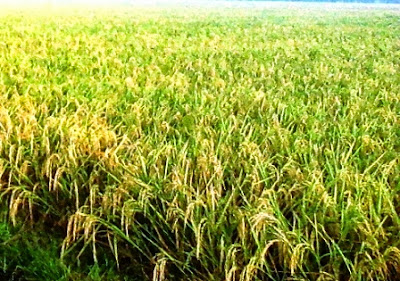
Rice is the most widely consumed staple food of the world’s, especially in Asia. Rice is the seed of the Rice Plant a monocot plant that have two main species Oryza sativa (Asian rice) and Oriza glaberrima (African rice) . This plant is origin to China (Pearl River valley) and spread to Southeast and South Asia since 1500 BC. Rice introduced to Europe through Western Asia. European colonization then bring it to Americas. Rice cultivation is also one of the most important human civilizations, now rice cultivation become the second largest food plant cultivation after maize (corn), and rice is the most important carbohydrate source of worldwide humans.  The importance of rice for mankind was illustrated from so much research projects and development of the quality and quantity of rice production, continues holds either by the various state agencies, universities and world research institutes such as the International Rice Research Institute (IRRI) . IRRI is an intern...